This was my first Christmas away from home.
I moved away over fifteen years ago and had been returning to my home in West Virginia at least annually and always at Christmas. This year we had a baby and traveling would prove to be complicated, so we decided to spend our first Christmas in Los Angeles.
While I certainly missed my parents, my brother, my family, my friends, it was wonderful being with my wife and son. Absolutely wonderful.
Back at home, my brother just had twins. My grandmother, my mother’s mother, passed away this summer and my grandfather moved in with my parents – or at least is in the process of doing so.
At my parents’ house, Christmas is rather hectic as it is. This year with so many changes, ironically, I think it wound up being more relaxed and perhaps a little quieter for everyone. It’s a new chapter and I think a great one, certainly an exciting one.
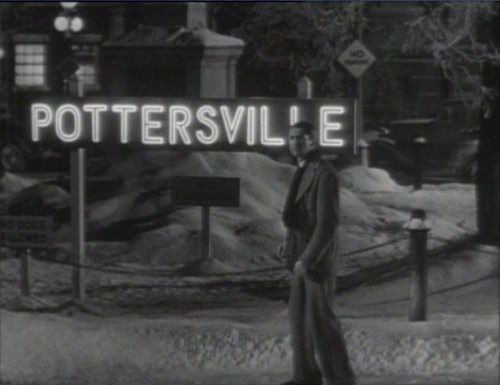
As I curled up on my couch late on Christmas eve to watch It’s a Wonderful Life as I’ve done countless times before, I was struck by how much resonance the movie still has after all these viewings, particularly now, helped, no doubt, by the fact that I was so many miles from home.
Watching the back and forth between George Bailey and Mr. Potter early in the film, about the town needing the building and loan if only to have some place where people could come without crawling to Potter – I couldn’t help but be reminded about the current state of things in the country.
Many folks in our country are a nostalgic bunch, myself included, and I suspect that this was true almost immediately. I wouldn’t be surprised if American citizens in the early 1800s waxed nostalgic about the salad days of the United States – you know, that period immediately following the signing of the constitution – and how things went south quickly after.
But as Billy Joel said, “The good old days weren’t always good…” (Incidentally, Joel’s 1985 video for “You’re Only Human” was based on It’s a Wonderful Life, with Joel in the “Clarence” role).
There’s so much revisionist history and revisionist history criticism that it’s unlikely that a town exactly like Bedford Falls ever even existed. But you see, that’s ok – cause it’s just a movie.
You hear similar intellectual criticism about Walt Disney’s Main Street USA. As the folklore goes, it’s reminiscent of the streets Walt actually grew up on. In reality, it was probably far more dirty.
So we put on rose colored glasses. Look, we do that. Hell, I do that. I think I grew up in one of the greatest small towns in America – and it was a shadow of what it was when my dad grew up there.
But as long as we’re aware that we’re confusing fantasy with reality, it’s ok. Though I think sometimes we get into trouble when we forget:
We are confusing fantasy with reality.
If you want to know the genius of Ronald Reagan and why those that remember him so fondly do so, Buzz Bissinger sums it up brillantly and succinctly in Friday Night Lights:
They worshipped Ronald Reagan not because of the America that Reagan actually created for them but because of the type of America he so vividly imagined.
In a sense, all effective politicians (and other pop artists) have an uncanny ability to create a nostalgia for the future. In other words, hope. But when that vividly imagined future arrives, without the polish of the promise, the past takes on an even richer glow. And we believe that things were better way back when in Bedford Falls.
And of course, for some of us, in some ways, they were. But in others ways, for other people, they were not. And that’s the genius of the movie if we look at it without the nostalgia. In many ways, the movie is a tragedy:
Let’s remember, this is a movie about a man whose dreams did not come true.
Trying his damnedest, George did not shake the dust of his crummy little town off his feet and see the world because that crummy little town needed him and he, in effect, saved it because he sacrificed his own American dream.
I’m reminded of a dear friend of mine who is far less idealistic than I am, but ironically introduced me to It’s a Wonderful Life. As much as he criticized (and perhaps rightly so) the trivial pursuit of dreams (American or otherwise), he very practically wanted to stay in the same town that he grew up in and teach school when he “grew up”. That was his American Dream. But by the time he reached adulthood and was armed with a teaching degree, there were were no available teaching jobs in town. So like most of the rest of my friends, he moved out of town. He was actually forced to shake the dust of the town off his feet and see the world.
He’s got a beautiful house, beautiful family and a great job. I think he still believes dreams, for the most part, are bullshit. And in a lot of ways, maybe he’s right.
Now, I recuse myself as an objective example of the small town exodus because no matter how booming the economy was, I was going to have to leave town to try and make movies. (However, I might very well have had just as good a shot at doing what I want to do a few miles outside of Pittsburgh than I do right smack dab in the middle of Los Angeles, but that’s probably another essay…)
I digress…
When I think of my father and his generation, while where I grew up wasn’t exactly Bedford Falls, for the sake of argument, let’s say it was exactly like Bedford falls. Once.
I imagine anyone who grew up in a small town sees a bit of Bedford Falls there, though not without its warts, there was a time (long before I was there) that my town was thriving, like most American small towns. And perhaps that’s why my father’s generation managed to stay there:
Like George, they loved the place so much they tried their damnedest to resuscitate it.
It’s interesting to note that my dad was born the same year It’s a Wonderful Life was released, 1946, along with the rest of that first batch of Baby Boomers. And let’s remember, that Baby Booming post-WW II optimism is a large part of why the movie wasn’t much of a box office hit. It actually wasn’t until around when I was born, in the 70’s, and the thing started running constantly on TV – and some small towns in America showed the first signs of decline – that it became one of the most beloved movies ever made.
In essence, Yesterday had to rest firmly and securely in the past, far enough that we couldn’t quite see it anymore, before we could adequately view it for the “flawless” time it was.
Many people poo poo the idealistic, romanticized, nostalgia-cornball nature of It’s a Wonderful Life. If someone were in a jam like George is at the end of the movie, would everyone pull together to help him like that today?
Sure they would, but what’s completely screwed up about today? Now we bail out Potter.
We bailed out the banks! Potter is the 1
percent. The elite. The guy with more money than he knows what to do with and is intent on screwing the other guy no matter the cost.
percent. The elite. The guy with more money than he knows what to do with and is intent on screwing the other guy no matter the cost.
I’m not sure about the math, but I’m curious about what the state of the economy would be today if instead of bailing out the banks, the governement jumped in and helped forgive every citizen’s debts or paid off their mortgage. How much would that have cost? In short, what would have happened if we bailed out George, the working stiffs, instead of Potter, the Bank presidents?
Sure, the people that were prudent and not in trouble would have been upset. But they’re not dancing in the streets now. Just because we bailed out the corporations doesn’t make it any less “socialist”.
Ok, maybe my analogy is fuzzy. Maybe the banks are George Bailey? But if so, why aren’t we all singing “Auld Lang Syne” and cheering about Wall Street being the richest man in town? I’m sticking with the “We bailed out Potter” thesis.
As a result of this way of doing things, (that probably had its genesis around the time It’s a Wonderful Life was on TV constantly at Christmastime) George Bailey doesn’t really have a choice anymore. A guy like that can’t stay in Bedford Falls because there’s no such thing as Building and Loans anymore. Just like there’s no such place as Bedford Falls anymore. But maybe now, it’s for the best, because maybe George should have just left in the first place.
Mary loved him enough to follow him anywhere and if George went in on the ground floor of the plastics business with Sam, he would have had adequate funds to buy Potter out and get him the hell out of Bedford Falls!
At the end of the day, there’s nothing wrong with making money. And everyone that’s rich isn’t a Mr. Potter. Just like everyone that’s poor isn’t some lazy guy that’s not looking for a job.
I happen to know that there are George Bailey types that grew up in Bedford Falls-like places and now work at Goldman Sachs that aren’t vampire squids, just as I know people born of privilege that haven’t managed to accomplish a damn thing.
We really can’t paint with broad strokes anymore, it doesn’t do us any good. Some people that worked at the banks screwed up and screwed many of us because they were either as competent as Uncle Billy or as crooked as Mr. Potter or perhaps a little of both. But what’s done is done and we must move forward.
Ultimately George Bailey was a successful guy, a happy guy and thanks to the modest bailout from his friends, he probably wound up doing ok, even if his American Dream wasn’t realized.
And let’s remember, the American Dream isn’t the same thing for everyone, both in its detail and in its broad strokes. For some it might be a mansion on a hill, but for others it’s simply working, paying, living and dying in a couple decent rooms and a bath. So let’s hope the rest of what Billy Joel said is also true: “tomorrow ain’t as bad as it seems.”
Either way, we have no idea what tomorrow really holds, because The American Dream is just that: a dream. Not a promise. Not a right. What’s realized, like the life of George Bailey, is something drastically different, the promise without the polish, leaving us longing for the past.
But isn’t it worth holding onto some of the small town ideals that give us a fighting chance to achieve something better, even it’s different from what we imagined? Maybe we don’t get to teach school in the town where we grew up, but maybe, if we’re lucky, we’re still able to educate and make a home someplace else.
We’ve been screaming so much about the American Dream lately, which, like it or not, is part of our nostaligic past. After all, at the end of the day, the American Dream is really just an elusive idea that either drives us from where we were brought up or keeps us bound there until we grow older, discover our raisins in the sun, and courageously find our way home.
 C I P R I A N I
Leave a comment